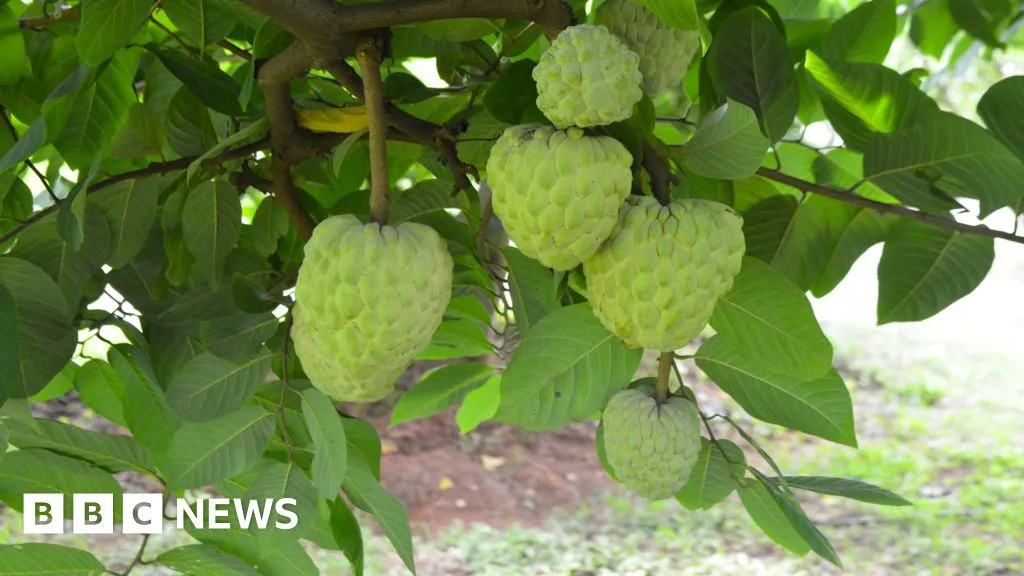
Custard apple, a fruit revered for its custard-like texture and delightful sweetness, is gaining recognition beyond local markets, thanks to innovative farmers in India. Known for their ability to thrive in challenging conditions, custard apple trees are not only resilient but also show immense potential for economic growth.
A Family's Journey Back to the Land
In the drought-prone region of Kolar, southern India, Ashoka Shivareddy faced the harsh realities of farming. "The area receives only 60 to 70 centimeters of rainfall, forcing farmers to dig borewells up to 1,300 feet deep," he explains. After facing significant losses, his family left agriculture for urban life in Bengaluru, where he worked as an AI software engineer.
However, the call of the land remained strong. In 2018, Shivareddy returned to his farming roots, seeking a crop that could endure with minimal water and limited pesticide usage. He found his answer in custard apples, a unique fruit native to his region.
Maximizing Yields with Innovative Farming
Shivareddy adopted a scientific approach to cultivation, planting custard apple trees in closer proximity than typical practices suggest. By selecting three distinct varieties of the fruit, he succeeded in significantly boosting his yield to around 25 tonnes last year, reflecting a burgeoning demand in both India and international markets.
While custard apples can withstand low water levels, challenges remain. Traditional varieties, like Balangar, struggle with a short shelf life of just three to four days and high seed content that can deter buyers. Moreover, the seeds are toxic, necessitating caution during consumption. Dr. Sakthivel T, a principal scientist at the Indian Institute of Horticulture Research (IIHR) in Bangalore, notes, "While traditional varieties excel in taste, they often lack pulp and have low marketability."
Innovations in Hybrid Varieties
To combat these challenges, researchers have developed a hybrid called Arka Sahan. This new variety remains fresh for up to a week at room temperature, features fewer seeds, and contains significantly more pulp, yielding around 70% pulp recovery compared to just 30% in wild varieties. This innovation effectively doubles the usable harvest without the need for additional land.
Moreover, efforts are underway to improve post-harvest processing techniques, as custard apple pulp tends to brown quickly, limiting its appeal in processed foods like ice creams and milkshakes.
Leading the Way in Production
Maharashtra has emerged as the leading custard apple-producing state in India, contributing nearly a third of the nation's output. Farmers like Navnath Malhari Kaspate have dedicated decades to cultivating and enhancing custard apple varieties. Kaspate has innovated the NMK-01 variety, recognized for its high yield and longer shelf life, opening doors to export opportunities previously unseen in this industry.
"We grow custard apples over nearly 50 acres, producing around 10 tonnes per acre. This variety's resilience has allowed us to export to Gulf countries and Europe on an unprecedented scale," Kaspate states.
Looking Ahead: Meeting Global Demand
Exporters, including Manoj Kumar Barai, favor the NMK-01 custard apple for its superior quality, thicker skin, and enhanced flavor. As the market for this delectable fruit continues to grow, innovative farming techniques and dedicated research are paving the way for a brighter future, not just for farmers in India but for consumers worldwide who are eager to experience the taste of custard apple.
As the demand for this unique fruit expands, it’s clear that the custard apple is more than just a resilient crop; it’s a testament to the ingenuity of farmers looking to carve new paths in global agriculture.
Source: BBC News - Technology