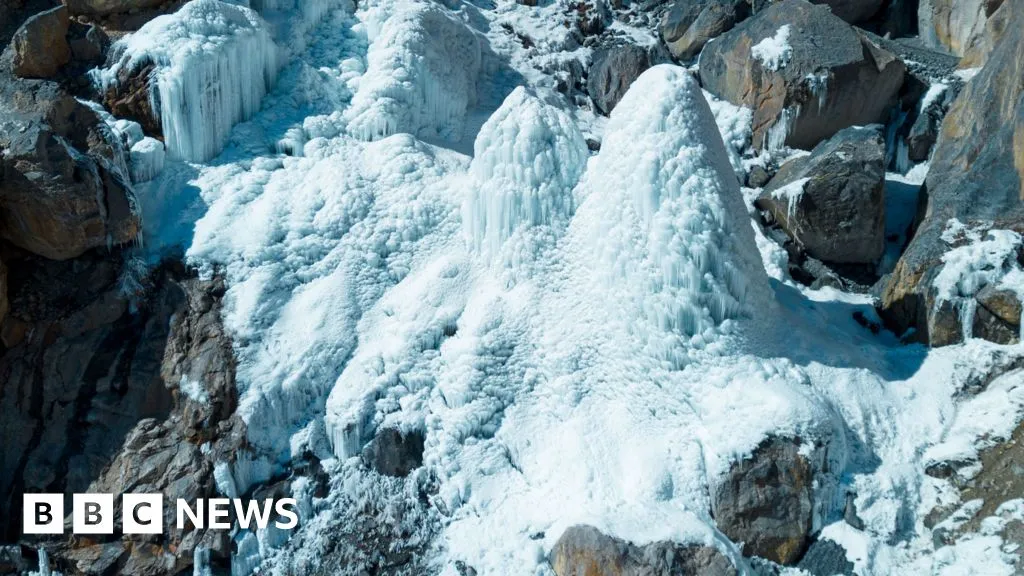
In the remote Himalayan village of Sakti, located nearly 4,000 meters (13,000 feet) above sea level, farmers face daunting challenges brought on by climate change. With scant rainfall and harsh conditions, agricultural life here is extremely tough. As Gelak Gutme, a lifelong farmer in the region, explains, “Ladakh has a brutal single-cultivation season.”
For over 65 years, Gutme has cultivated wheat, peas, and potatoes in this harsh environment, which has only worsened due to global warming. Traditional glaciers that once provided essential water supplies for crops have shrunk dramatically. “Last year, I lost everything—my entire field dried up due to lack of water,” Gutme recounts, shedding light on the agricultural crises faced by local farmers.
The Role of Artificial Glaciers
Historically, small glaciers acted as natural water reservoirs, storing water throughout the winter and gradually releasing it as spring arrived. However, as these vital resources disappear, villagers are turning to innovative methods to secure their agricultural future.
In the early 2010s, some communities in Ladakh began experimenting with a groundbreaking idea: creating artificial glaciers, known as ice stupas. This ingenious system involved piping water from higher altitudes and spraying it into the air where it would freeze into large, pyramid-like structures. These artificial formations provided vital meltwater come springtime. While they initially showed promise, managing these structures under bitterly cold conditions proved challenging.
Advancements in Ice Reservoir Technology
“Many farmers camp in the mountains during severe winter nights to monitor the systems,” notes Lobzang Fardod, a member of a local water management committee. The experience of dealing with freezing temperatures and potential pipe blockages was daunting. But as traditional systems faltered, a new technological solution emerged.
The Ladakh Autonomous Hill Development Council has spearheaded a wave of grassroots engineering innovations, turning Leh—Ladakh’s capital—into a center for sustainable water solutions. The latest advancement, known as the Automated Ice Reservoir (AIR), was developed in collaboration with the private company Acres of Ice.
The AIR system employs vertical jets of water that freeze instantly, forming robust towers of ice while minimizing previous issues associated with the ice stupa method. Dr. Suryanarayanan Balasubramanian, the founder of Acres of Ice, explains that water is pumped down from the mountains, creating a controlled icy environment. “It shoots out of a vertical nozzle like a massive fountain,” he describes, highlighting the efficiency of the new system.
A Smart Approach to Ice Production
[p]Integrating advanced technology, the AIR system is equipped with weather stations that measure various environmental conditions, including air and water temperatures. These sensors ensure the system operates efficiently; if temperatures drop too rapidly, the control system drains the water, preventing damaging ice blockages in the pipes.
Instead of a continuous spray, the AIR system releases bursts of mist to coat the existing ice, allowing it to freeze solid before the next application, optimizing water usage in this unforgiving climate.
[h3]Conclusion[/h3>
With these innovative approaches, Himalayan villages are pioneering effective solutions to combat the effects of climate change on their agriculture. As they adapt and overcome the challenges ahead, these communities offer inspiring lessons in resilience and ingenuity.
For further insights, explore the artificial glacier initiatives in India's mountain villages and the future of sustainable water management.
Source: BBC News - Technology