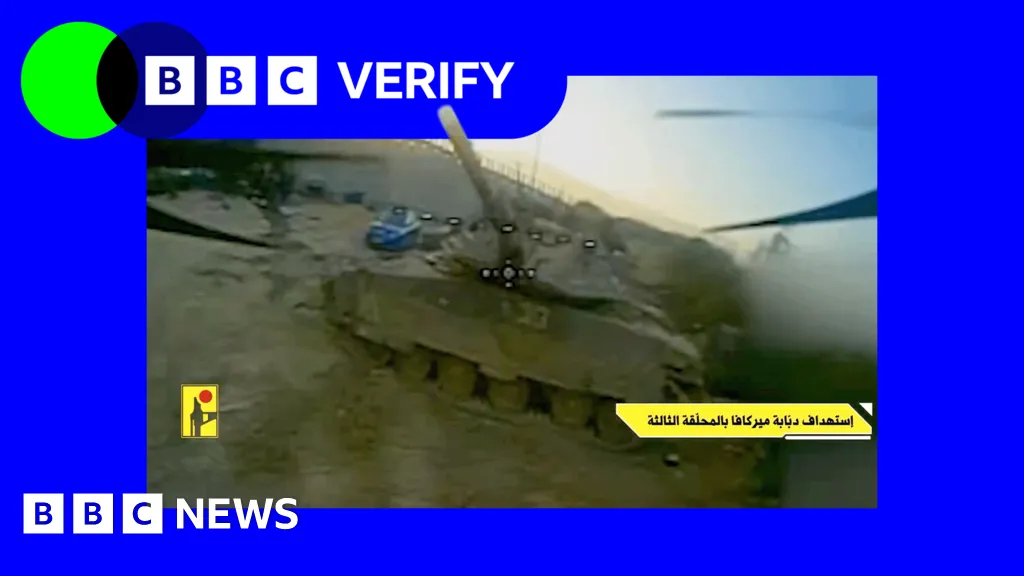
In a significant shift in military strategy, Hezbollah has ramped up its deployment of small first-person view (FPV) drones for targeting Israeli forces, showcasing a new level of tactical innovation.
Geolocation and Video Analysis
A recent investigation by BBC Verify has analyzed over 35 verified videos of drone strikes shared by the Lebanese group since March 26, illustrating attacks on Israeli soldiers, armored vehicles, and air defense installations in southern Lebanon and northern Israel. These FPV drones, often operated via fiber-optic cables, have proven challenging for Israeli defense systems to detect and counter.
The Effectiveness of FPV Drone Warfare
Experts suggest that the Israel Defense Forces (IDF) currently struggle to develop effective countermeasures against these small UAVs, which can easily bypass traditional detection systems. The shift to FPV drones mirrors tactics observed during the Russia-Ukraine conflict, where similar methods have redefined contemporary warfare.
Impact on Israeli Casualties
While detailed casualty figures have not been fully disclosed by the IDF, Israeli media reports indicate that recent FPV strikes have resulted in the deaths of four soldiers and one civilian, with numerous injuries reported.
Israeli Defense Responses
In response to this evolving threat, the IDF acknowledges the risk posed by drones and is channeling considerable resources into enhancing its defenses. This includes developing more effective alert models and conducting training to improve soldiers' readiness to deal with these advanced aerial threats.
Expert Insights on Drone Technology
Hisham Jaber, a military analyst and former general in the Lebanese army, noted that the FPV drones can be nearly undetectable by radar, highlighting their growing presence and operational capabilities within Hezbollah's arsenal. Jaber elaborated that while Hezbollah has utilized various types of larger attack drones for years, the emergence of FPV drones represents a marked tactical shift.
Documented Drone Strikes
BBC Verify has identified approximately 100 suspected FPV attacks shared on Hezbollah's Telegram account since late March, with 35 verified instances. Notably, one striking video depicts multiple FPV drones targeting an Israeli border outpost near Kiryat Shmona, resulting in significant damage to military vehicles.
Implications of Fiber-Optic Technology
Many of these drones utilize fiber-optic connections rather than traditional wireless signals, complicating interception efforts. Dr. Andreas Krieg, a security expert from King’s College London, emphasized that this technology limits Israel's ability to detect and jam the drone signals effectively, posing an increased risk to their forces. As a result, Israeli troops are forced to adopt more cautious strategies, including fortifying positions and enhancing local defense measures.
The Cost-Effectiveness of UAVs
Experts estimate that these FPV drones, which can be constructed from commercially available parts and 3D-printed components, cost between $300 and $500 each. Leone Hadavi, a senior investigator at the Centre for Information Resilience, indicated that this affordability allows Hezbollah to threaten valuable Israeli assets effectively.
Psychological Warfare
The psychological impact of these drone strikes on Israeli troops cannot be overlooked, with the potential to instill significant fear regarding the vulnerability of even the most defended armored vehicles. This escalation in hostilities marks a notable chapter in the ongoing military dialogue between Israel and Hezbollah, which reignited following tensions surrounding high-profile actions against Iranian leadership.
Continuing Tensions in the Region
The conflict's recent escalation began on March 2, following a wave of US and Israeli air strikes targeting Iran. With tensions running high and military strategies evolving, the implications of these developments will undoubtedly shape future engagements in the region.
For further insights, visit the original source: BBC News.
Source: BBC News - World